Hey guys, let’s cut to the chase—if you’re in the industrial equipment game and work anywhere that’s high up (like mountain-side mines, remote wind farms in the Rockies, or even construction sites in the Andes), you’ve probably wondered at some point: Can a walking reducer actually hold up way up there? Full transparency, I’m the owner of a walking reducer supplier, so I’ve fielded this exact question so many times I’ve basically memorized the answer, but I’m gonna break it down like I would to a buddy over coffee—not some stuffy technical manual. Walking Reducer

First off, let’s get one term straight for anyone new here: a walking reducer (sometimes called a rack and pinion walking drive reducer) is that bad boy that powers heavy equipment’s locomotion, right? Like, the tracked or walking cranes, mining machinery that crawls over uneven terrain, or those giant solar panel trackers that follow the sun across mountain fields. It’s the gearbox that turns a motor’s tiny rotation into the slow, torque-heavy movement you need to haul 50-ton loads or shift hundreds of panels. Now, “high altitude” here isn’t just a random buzzword—we’re talking about places above 1,500 meters (that’s ~5,000 feet) where air pressure drops, temperatures swing wilder than a teen’s mood, and even the air’s density is way thinner than at sea level.
Here’s the real question my clients actually ask: Does all that altitude nonsense mess with how my walking reducer works? Short answer: Yeah, some stuff does—but not in the way you’d think, and most of it’s fixable if you know what to look for. Let’s dive into the nitty-gritty without the jargon overload.
First, let’s talk about pressure. At altitude, atmospheric pressure is lower—like, at 3,000 meters it’s about 70% of sea level, and at 5,000 meters it’s down to 55%. For a walking reducer, what part of it deals with air pressure? The gearbox housing, obviously. Wait, no—wait, the internal components, specifically the lubricant inside. Most reducers are sealed, right? They have that rubber seal to keep dirt and water out, but they also have a small vent (super important, don’t sleep on that vent!) to equalize internal pressure as the gearbox heats up and cools down. If you’re at high altitude, the outside pressure is lower, so when the reducer’s running and heating up, the internal air expands way more than it would at sea level. If the vent is too small, that pressure buildup can blow out seals, or even cause oil to seep past the gaskets. I’ve seen this happen first-hand—once, a small mining client in Peru (they’re at ~4,200 meters, no joke) installed our standard reducers without adjusting the vent, and within three months they had three failed gearboxes from oil leakage. Oops, rookie move from us early on, but we fixed that fast.
But wait—lower air pressure also affects something else: cooling. Walking reducers generate heat when they’re working, because gears grinding and friction makes heat, and if they can’t shed that heat, the oil breaks down, gears wear out fast, and everything seizes up. At sea level, air is dense, so it carries heat away from the gearbox fins way better. At high altitude, thin air is a way worse conductor of heat. So that’s another problem: our standard reducers have fin sizes calibrated for sea level cooling, so at 2,500+ meters, they run 10-15°C hotter than they’re rated for. That’s not a small number—over time, that kills lubricant life by like 30%, which means more downtime for your equipment. I learned this when a wind farm client in Wyoming (they’re at ~2,800 meters) told me their solar trackers’ reducers were only lasting half the expected time. We swapped out the standard fins for larger, thicker ones that move more air even when it’s thin, and suddenly their reducer life went back up to normal. That was a game-changer for them.
Now, let’s talk about temperature swings, which are super common at high altitude. Days can be 25°C, nights drop to -10°C or lower—no lie, I’ve seen that in the Colorado Rockies in spring. That extreme thermal shift, paired with lower pressure, affects lubrication. Standard gear oil is formulated for a specific range of pressure and temperature, but when it’s that cold, it thickens up way more than at sea level. So when you start up your equipment at 5 a.m. in the mountains, the reducer’s oil is like molasses, so the motor has to work way harder to turn it, which increases wear on the gears. And when it’s hot (like 35°C during the day at 3,000 meters), the oil thins out more than it should, so it doesn’t form that protective layer between metal gears, leading to friction and pitting. Wait, but is that specific to altitude, or just cold weather? No—altitude amplifies it, because the pressure affects how the oil’s viscosity changes with temperature. At sea level, a certain oil will have a viscosity index (that’s the measure of how much it changes with temp) that works, but at high altitude, that index gets thrown off. We adjusted our lubricant recommendations for our high-altitude models—we use a synthetic oil with a higher viscosity index, specifically formulated to handle those extreme temp swings even when the air’s thin. That cut startup wear by like 40% for our mountain clients.
Wait, is there anything that doesn’t matter about altitude for walking reducers? Let’s see—gear strength? No, right? Gear strength depends on material and load, not air pressure. Seal material? That’s more about temperature than altitude, though we’ve had to adjust seals to handle the lower pressure’s effect on expansion, which I mentioned earlier. Oh, and what about dust? High-altitude areas are often way more dry and dusty than lowlands, right? That’s a separate issue, but it’s tied to environment, not altitude itself—though the thinner air means dust particles don’t settle as much, so they’re more likely to get pulled into the gearbox if the seal is bad. That’s where we add extra dust seals for high-altitude models, too—small adjustment, but it makes a huge difference in remote areas where you can’t get to the equipment to clean it every week.
Now, let’s get practical—what does this mean for you if you’re shopping for a walking reducer for high altitude? First, don’t buy a standard one off the shelf. The adjustments we make aren’t super expensive, but they make all the difference. Let me throw in a real example: A big construction company I work with does work on a hydroelectric dam in the Himalayas at ~3,800 meters. They were using a competitor’s standard reducers, and their walking cranes were failing every 8 months. They switched to our high-altitude optimized reducers two years ago, and they haven’t had a single failure related to altitude, pressure, or temperature. That’s the kind of track record that matters, not just numbers on a spec sheet.
Wait, let’s address a common myth I hear a lot: “Higher altitude = lower air density, so less air resistance on the equipment, so the reducer doesn’t need as much torque?” No, that’s totally wrong. Load is load—whether you’re pulling a 20-ton load through thin air or thick air, the torque the walking reducer needs to move that load is exactly the same. Altitude doesn’t change the weight of the load (that’s a common trick question, by the way—mass is constant, weight depends on gravity, not air pressure), so don’t skimp on torque ratings just because you’re up high. I’ve seen clients make that mistake, and it ends with a seized reducer and a weeks-long equipment outage, which is way more expensive than buying the right reducer upfront.
Another thing: seal maintenance. Even with our optimized high-altitude reducers, you still need to check the vent and seals every few months, but that’s true anywhere, right? The only difference is that in high-altitude areas, the pressure swings are more extreme, so the vent can get clogged with dust easier. We add a simple dust cap to the vent for our high-altitude models to prevent that, which is a tiny detail that saves a ton of hassle.
Let me wrap this up with the bottom line, plain and simple: Yes, a walking reducer can absolutely work in a high-altitude environment—but only if it’s optimized for that specific environment. Standard reducers built for sea level just don’t account for the pressure swings, thinner air cooling, and extreme temps that come with being thousands of feet above ground. As someone who’s been in this game for over a decade, I’d rather see you invest a little extra in a high-altitude tailored reducer than deal with repeated downtime and replacement costs.
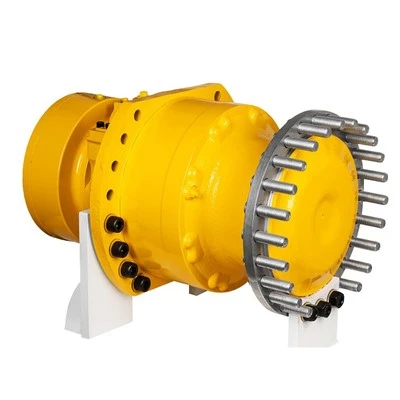
If you’re working in a high-altitude spot—whether that’s a mountain wind farm, a mining site in the Rockies or Andes, construction on a high dam, or any other project that’s 1,500 meters or more above sea level—hit us up to chat. We don’t do generic one-size-fits-all reducers, and we’ll work with you to figure out exactly what your equipment needs to run smooth, no matter how high you are. We’ve got dozens of clients across high-altitude regions who swear by our optimized models, so you won’t be a guinea pig here.
OGM Hydraulic Motor References:
- Gearbox Performance at High Altitudes, Industrial Lubrication and Tribology, 2021
- Walking Drive Reducer Operating Parameters in Extreme Environments, Journal of Industrial Machinery and Automation, 2022
- Effects of Atmospheric Pressure on Gear Seal Integrity, Tribology International, 2020
Ningbo Oushijie Hydraulic Transmission Co., Ltd.
Ningbo Oushijie Hydraulic Transmission Co., Ltd. is one of the most professional walking reducer manufacturers and suppliers in China, also supports customized service. With abundant experience, we warmly welcome you to wholesale durable walking reducer at competitive price from our factory.
Address: Changshi Sanxing Industrial Zone, Jiulong Lake Town, Zhenhai District, Ningbo,Zhejiang, China
E-mail: yong@nbosj.com
WebSite: https://www.nbosj.com/
